I am learning flutter from JustAcademy, They provide very much great environment where people gather and work simultaneously. totally project based training institute.
MOHD ABU BAKAR ANSARI
Flutter Developer
Awesome Experience. I am a Front-end Web Designer working at Star India for 3 years now. I applied for Full-stack development and my experience has been phenomenal & they really do help with placements exceptionally. Thank you Roshan sir so much.
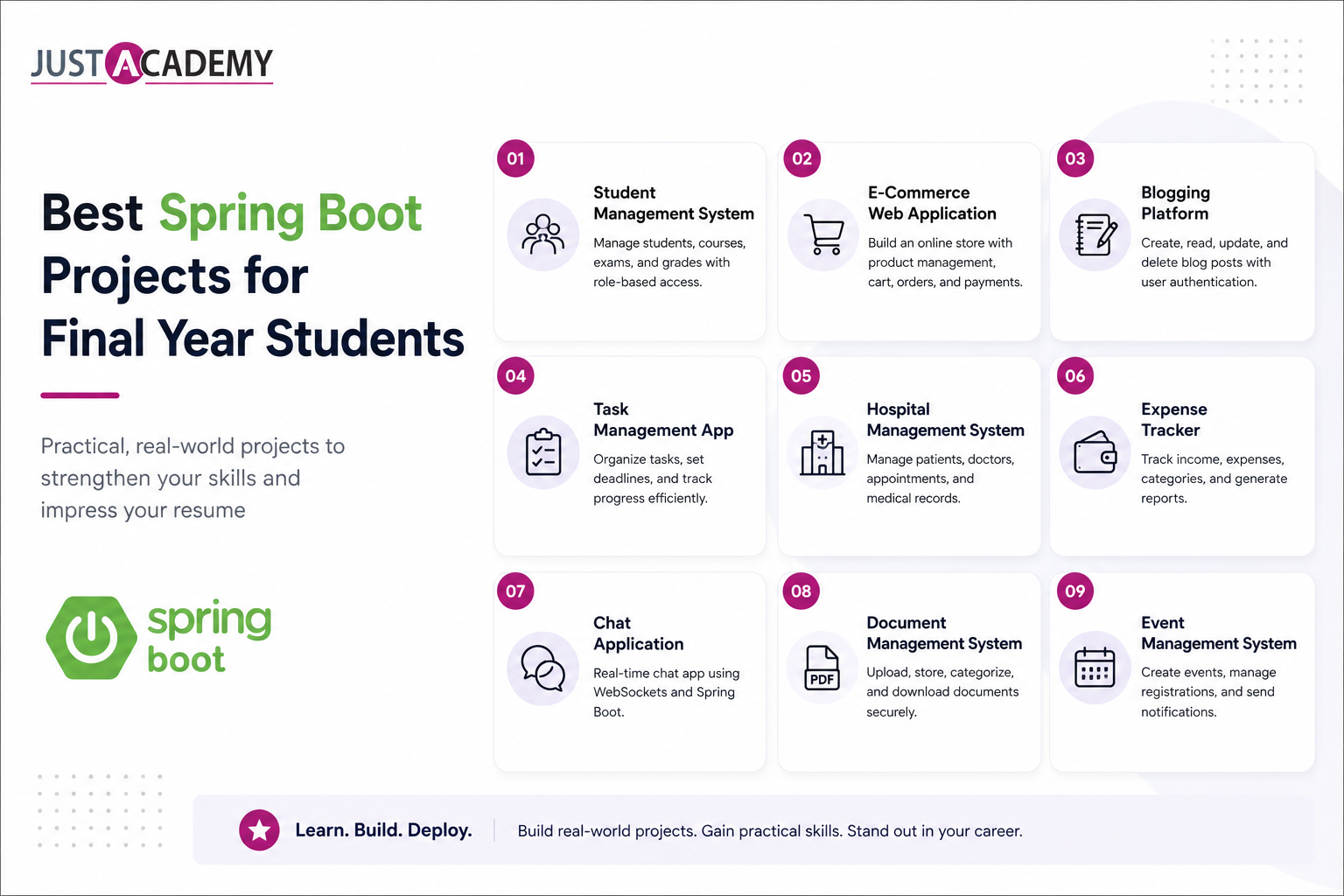
Final year engineering students in India in 2026 face one of the most competitive job markets in the country's technology history. Companies visiting campuses, IT services firms hiring through pool campuses, and startups recruiting directly all expect students to demonstrate practical skills that go beyond academic theory. Spring Boot has become the most in-demand Java backend framework across the Indian enterprise technology landscape and building strong Spring Boot projects before placement season is one of the highest-return investments a final year student can make.
Spring Boot projects serve multiple purposes simultaneously for engineering students. They demonstrate technical proficiency to placement interviewers. They provide the hands-on experience that transforms textbook knowledge into genuine coding ability. They create talking points for HR and technical rounds that distinguish candidates who have built something real from those who have only attended lectures. And they develop the problem-solving instincts and debugging skills that cannot be taught in classrooms but are assessed in every technical interview.
This blog covers the best spring boot projects for students at every skill level from beginner mini projects that can be completed in a week to advanced capstone projects that genuinely impress placement interviewers. Each project includes the technology stack, business context, key technical concepts covered, and specific guidance on what to add to make it stand out. Whether you are preparing through the best Java course in Mumbai or through a live interactive online training program, these project ideas give you a clear, practical path from student to job-ready developer.
Why Spring Boot Projects Are the Best Final Year Investment for Engineering Students
Spring Boot Is the Most In-Demand Java Framework in India
Spring Boot appears in the majority of Java developer job postings at Indian IT services companies, product startups, banking technology firms, and global technology companies with India development centers. Understanding why requires context. Spring Boot solves the most painful problems of traditional Java enterprise development. It eliminates verbose XML configuration. It packages applications as self-contained executable JARs with embedded servers. It provides auto-configuration that sets up sensible defaults based on the dependencies present in the project. And it integrates seamlessly with the entire Spring ecosystem covering data access, security, messaging, and cloud services. The result is faster development with less boilerplate code and the reasons Indian companies have adopted it broadly are precisely the same reasons interviewers assess it heavily in placement rounds.
Placement Panels Respond Immediately to Spring Boot Projects
Final year placement panels at engineering colleges in India in 2026 include both HR interviewers who assess communication and attitude and technical interviewers from the hiring companies who assess coding skills. Technical interviewers at IT services companies like TCS, Infosys, Wipro, HCL, and Cognizant are specifically looking for students who understand REST APIs, database connectivity, and basic Spring Boot architecture. A student who can explain a project they built using Spring Boot, describe the entity relationships in their database schema, explain how JWT authentication works in their security implementation, and demonstrate the API endpoints through Postman or a running demo immediately stands out from the majority of students who can only discuss theory from textbooks.
Projects Develop Skills That Classroom Learning Cannot
There is a fundamental difference between knowing that Spring Boot uses Dependency Injection and having debugged a BeanCreationException at two in the morning because of a circular dependency in your own project. The practical problem-solving experience gained from building real projects develops intuitions and capabilities that no amount of lecture attendance or exam preparation can replicate. Final year students who build two or three complete Spring Boot projects before placement season arrive at interviews with a qualitatively different level of confidence and competence that is immediately visible to experienced interviewers.
The Window for Building Projects Is Narrower Than Most Students Realize
Final year students consistently underestimate how quickly placement season arrives relative to when they start serious project work. The academic calendar, examination schedules, and placement preparation activities compress the available project-building time significantly. Students who begin building projects in their penultimate semester and refine them in their final year have a dramatically stronger portfolio by placement time than those who start in the final semester when examinations and placement interviews are happening simultaneously. Starting now, regardless of your current skill level, is always the right decision.
Best Spring Boot Mini Projects for Engineering Students to Start With
Project 1: Student Result Management System
Overview
A student result management system is the ideal first Spring Boot project for engineering students because it is immediately relatable, covers all the fundamental Spring Boot patterns, and produces a useful application that college administrators actually recognize as valuable. The system allows administrators to manage student records, subject registrations, marks entry, grade calculation, and result publication.
Technology Stack
The backend uses Spring Boot with Spring MVC for the REST API layer, Spring Data JPA with Hibernate for database operations, MySQL for the relational database, Lombok for reducing boilerplate in entity classes, Maven for project management, and a global exception handler using ControllerAdvice. The frontend uses Thymeleaf templates for server-side rendering or a simple React frontend consuming the REST API.
Key Technical Concepts Covered
Concept
Application in This Project
Spring Boot REST API
CRUD endpoints for students, subjects, and results
JPA entity mapping
Student, Subject, Result, and Department entities
Spring Data JPA
JpaRepository with custom query methods
MySQL schema design
Normalized tables with foreign key relationships
Exception handling
Custom exceptions with meaningful error responses
Service layer pattern
Business logic for grade calculation
Thymeleaf or React
Frontend for data entry and result display
What to Add to Make It Stand Out
Add a grade point average calculation engine in the service layer. Implement PDF result card generation using iText or JasperReports. Add search functionality for student results by roll number or name using Spring Data JPA's derived query methods. Implement basic Spring Security with username and password authentication for the admin panel. Write unit tests for the grade calculation service using JUnit 5 and Mockito. Deploy to a free platform like Railway or Render and include the live URL in the README.
Project 2: Online Complaint Management System
Overview
A complaint management system demonstrates workflow and status tracking capabilities that are directly applicable to real enterprise applications in banking, insurance, and government organizations. Users submit complaints, admins assign them to agents, agents update status, and all parties track progress through the resolution cycle.
Technology Stack
Spring Boot REST API with Spring Data JPA and MySQL. Spring Security with Basic Authentication protecting admin and agent endpoints. A complaint entity with status tracking using Java enums for SUBMITTED, ASSIGNED, IN_PROGRESS, RESOLVED, and CLOSED states. A simple React or HTML CSS JavaScript frontend for the user-facing complaint submission and tracking portal.
Key Technical Concepts Covered
Concept
Application in This Project
Enum-based status workflow
Complaint lifecycle state machine
User role management
Separate access for users, agents, and admins
Spring Security
Endpoint protection by role
Status filtering queries
Find complaints by status and assigned agent
Audit fields
Created date and updated date using JPA lifecycle callbacks
Email notifications
Spring Mail for status change notifications
REST API design
RESTful endpoint conventions for complaint operations
What to Add to Make It Stand Out
Add email notifications using Spring Boot's email starter when complaint status changes. Implement a priority system with SLA tracking showing days since submission. Add admin dashboard with complaint count analytics by status and category using Spring Data JPA aggregate queries. Implement file attachment upload for supporting documents using Spring's multipart support. Add pagination and filtering for the complaint list API.
Project 3: Online Quiz Application
Overview
An online quiz application is one of the most popular and well-received Spring Boot project choices for final year students because it has immediate real-world relevance to the EdTech sector and demonstrates multiple technical concepts in an engaging business context. The application manages question banks, quiz sessions, timer functionality, automatic scoring, and result history.
Technology Stack
Spring Boot REST API with Spring Data JPA and MySQL. A quiz engine in the service layer managing question selection, answer validation, and score calculation. Spring Security with JWT for student authentication. React frontend with a timer component, question display, answer selection, and result summary.
Key Technical Concepts Covered
Concept
Application in This Project
Random question selection
Service layer query for randomized question sets
JWT authentication
Secure quiz session tied to authenticated student
Session management
Quiz attempt tracking with start and end times
Complex JPA queries
Question selection by category and difficulty
Scoring algorithm
Service layer calculation with per-question scoring
Time tracking
Elapsed time calculation and timeout handling
Result analytics
Historical performance charts per student
What to Add to Make It Stand Out
Add multiple quiz categories with difficulty levels using many-to-many category relationships. Implement a leaderboard showing top scorers for each quiz. Add admin panel for question bank management with bulk upload from Excel using Apache POI. Implement question shuffling and option randomization per attempt. Add a review mode after quiz completion showing correct answers for incorrectly answered questions.
Project 4: Library Book Issue and Return System
Overview
A library management system is a classic project that covers data relationships, business logic, and workflow management comprehensively. The system handles book inventory, member registration, borrowing transactions, return processing, fine calculation for overdue books, and availability tracking.
Technology Stack
Spring Boot REST API with Spring Data JPA and PostgreSQL. Spring Scheduling for automatic daily fine calculation. Spring Security with role-based access for Librarian and Member roles. REST APIs for all library operations with proper HTTP status codes and error handling. A React or Angular frontend for the librarian console and a member self-service portal.
Key Technical Concepts Covered
Concept
Application in This Project
Transactional service methods
Atomic book issue and return operations
Spring Scheduling
Daily scheduled task for fine calculation
Date arithmetic in Java
Due date calculation and overdue detection
Business rule validation
Cannot issue if member has overdue books
Availability tracking
Book copy count management
Search and filter APIs
Find books by title, author, and category
Report generation
Monthly issue summary with Apache POI
What to Add to Make It Stand Out
Add a book reservation system where members can reserve unavailable books and receive notification when returned. Implement ISBN lookup integration using a public Google Books API to auto-populate book metadata. Add barcode simulation using a generated identifier for each physical book copy. Implement SMS notification for overdue books using a free SMS API. Generate PDF membership cards and borrowing receipts.
Advanced Spring Boot Projects That Impress Interviewers and Placement Panels
Project 5: Job Portal With Resume Upload and Application Tracking
Overview
A job portal application is directly relatable to placement interviewers because they understand its business context from their own experience. The application allows employers to post jobs and review applications and candidates to browse listings, upload resumes, and track application status through a multi-stage hiring pipeline.
Technology Stack
Spring Boot REST API with Spring Data JPA and MySQL. Spring Security with JWT authentication and separate Employer and Candidate role hierarchies. Spring's multipart file handling for resume and document uploads. File storage using local filesystem or AWS S3 integration. Spring Mail for application confirmation and status update emails. React frontend with separate employer and candidate dashboards and a rich text job description editor.
Key Technical Concepts Covered
Concept
Application in This Project
File upload and storage
Resume PDF upload with secure retrieval
Multi-role JWT security
Employer and candidate role-based access
Application pipeline
Multi-stage application status tracking
Full-text search
Job search by title, location, and skills
Email notifications
Application confirmation and status updates
Pagination and filtering
Job listings with multiple filter dimensions
Dashboard analytics
Employer view of application funnel statistics
Why This Project Impresses Placement Panels
Job portal applications are immediately recognized and valued by placement interviewers because they mirror the systems those very interviewers use to review applications. Demonstrating that you built the type of application they use daily creates an immediate connection and demonstrates domain relevance. The combination of file uploads, multi-role security, workflow tracking, and search functionality demonstrates a breadth of Spring Boot capabilities that simpler CRUD projects cannot match.
What to Add to Make It Stand Out
Implement skill-based job matching that recommends relevant jobs to candidates based on their profile. Add a notification system for new jobs matching a candidate's saved search criteria using Spring Scheduling. Implement an interview scheduling module where employers propose times and candidates confirm or request alternatives. Add a dashboard showing job market analytics like most in-demand skills and average salary ranges by role category.
Project 6: College ERP System
Overview
An ERP, or Enterprise Resource Planning system for a college environment is an ambitious and highly impressive final year project that demonstrates system-level thinking and integration across multiple functional modules. The system covers student admissions, course management, attendance tracking, fee management, examination scheduling, and result processing.
Technology Stack
Spring Boot with multiple service modules organized as separate packages or a modular monolith structure. Spring Data JPA with MySQL for a comprehensive relational schema. Spring Security with role-based access for Student, Faculty, Admin, and Finance roles. Spring Scheduling for automated tasks like attendance report generation and fee reminder dispatch. React frontend with role-based dashboards for each user type.
Key Technical Concepts Covered
Concept
Application in This Project
Modular Spring Boot design
Separation into admission, academic, and finance modules
Four-role RBAC
Different capabilities per user type
Complex entity relationships
Student, Course, Semester, Section, Fee entities
Scheduled automation
Daily attendance reports, fee reminders
Report generation
Academic transcripts and fee receipts as PDFs
Dashboard per role
Custom view for student, faculty, admin, and finance
Data validation
Business rules for enrollment prerequisites
Why This Project Is a Capstone-Level Achievement
A college ERP system demonstrates that you can design and build a multi-module application with complex entity relationships, multiple user roles, real business logic, and automated processes. Placement interviewers, particularly those from IT services companies that build enterprise applications for clients, immediately recognize this as production-grade ambition and reward it accordingly. The project also provides abundant material for technical discussion across architecture, database design, security, and feature implementation.
What to Add to Make It Stand Out
Add a student mobile interface using React Native or a Progressive Web App pattern. Implement real-time notifications using Spring WebSocket for urgent announcements. Add an academic analytics dashboard showing department-wise performance trends. Integrate a fee payment gateway simulation using Razorpay's test API. Add a document management module for certificates and transcripts with digital signature simulation.
Project 7: E-Commerce Platform With Order Management
Overview
An e-commerce platform covering the complete purchase workflow from product browsing through cart management, order placement, payment processing, and order fulfillment demonstrates business-critical application development skills that are directly applicable to e-commerce companies, retail technology organizations, and any company building transaction-processing systems.
Technology Stack
Spring Boot REST API with multiple controllers for products, cart, orders, users, and admin operations. Spring Data JPA with MySQL for a schema covering Product, Category, Cart, CartItem, Order, OrderItem, Payment, and User entities. Spring Security with JWT and Customer and Admin roles. Redis for cart session caching. React frontend with product catalog, cart interface, checkout flow, and order history.
Key Technical Concepts Covered
Concept
Application in This Project
Complex entity relationships
Cart, Order, OrderItem with product references
Transactional order placement
Atomic cart to order conversion with inventory update
Role-based product management
Admin-only create, update, and delete product endpoints
Redis caching
Cart data caching for improved read performance
Payment simulation
Order payment status tracking and confirmation
Inventory management
Stock decrement on order placement with reservation
Order status workflow
PLACED, CONFIRMED, SHIPPED, DELIVERED, CANCELLED states
What to Add to Make It Stand Out
Integrate Razorpay test API for realistic payment processing simulation. Add product search with autocomplete using Spring Data JPA full-text search. Implement product recommendations based on purchase history and category. Add coupon and discount code management with expiry and usage limits. Implement a seller module where multiple sellers can list products on the platform. Add order tracking with delivery status updates.
Project 8: Expense Sharing and Group Finance Application
Overview
A group expense sharing application similar to Splitwise demonstrates algorithmic thinking, complex business logic, and real-world utility that interviewers across all industries recognize. Friends create groups, add expenses, split them according to configurable rules, and track who owes whom what amount with settlement recommendations.
Technology Stack
Spring Boot REST API with Spring Data JPA and PostgreSQL. Complex service layer implementing expense splitting algorithms for equal, percentage-based, and custom splits. Spring Security with JWT for user authentication. Notification service using Spring Mail for expense additions and settlement reminders. React frontend with group management, expense entry, balance summary, and settlement tracking views.
Key Technical Concepts Covered
Concept
Application in This Project
Splitting algorithm
Equal and percentage-based expense distribution
Balance calculation
Running balance per user pair within group
Settlement optimization
Minimum transactions algorithm for debt resolution
Complex business logic
Multiple split types with validation rules
Group membership
Many-to-many user-group relationship
Transaction history
Complete audit trail of all expense and settlement events
Currency handling
Multi-currency support with exchange rate tracking
Why This Project Stands Out Academically and Professionally
This project is rare in student portfolios because it requires genuine algorithmic thinking for the settlement optimization, not just standard CRUD operations. The minimum transactions algorithm for resolving a web of mutual debts is a problem that demonstrates computer science fundamentals applied to a real-world use case. Interviewers from fintech companies and product startups are particularly impressed by this type of problem-solving demonstration.
Project 9: Healthcare Appointment and Telemedicine Platform
Overview
Healthcare technology is one of the fastest-growing sectors for backend developers in India. A telemedicine platform covering patient registration, doctor profile management, appointment booking with availability slot management, video consultation links, and prescription management demonstrates domain awareness in a sector with strong hiring momentum.
Technology Stack
Spring Boot REST API with Spring Data JPA and MySQL. Spring Security with JWT and Patient, Doctor, and Admin roles. Custom appointment availability validator checking doctor schedules before confirmation. Spring Scheduling for appointment reminders. Twilio or similar API integration for SMS confirmations. React frontend with a patient booking portal and a doctor management console.
Key Technical Concepts Covered
Concept
Application in This Project
Slot availability algorithm
Time-based availability checking with buffer periods
Three-role security
Patient, Doctor, and Admin permission boundaries
Custom Spring validators
Appointment overlap and eligibility validation
Medical record privacy
Patient data accessible only to treating doctor and patient
Scheduled reminders
Automated appointment reminders via email or SMS
Prescription management
Digital prescription with medication and dosage details
Consultation history
Complete interaction history per patient-doctor pair
What to Add to Make It Stand Out
Add a symptom checker using a simple rule-based engine that recommends doctor specialization. Implement health record sharing where patients can grant other doctors access to specific records. Add a telemedicine video link generation using a third-party video API. Implement insurance claim document generation as PDF. Add a doctor review and rating system with moderation.
A food delivery application built as a microservices architecture is the most technically impressive project in this list and is appropriate for students who have already built a monolithic Spring Boot project and want to demonstrate advanced architectural knowledge. The application consists of separate services for user management, restaurant catalog, order processing, payment, and delivery tracking.
Technology Stack
Multiple Spring Boot microservices each with their own database. Spring Cloud Gateway for API routing. Eureka Server for service discovery. Config Server for centralized configuration. Docker Compose for running the complete system locally. Feign clients for inter-service HTTP communication. RabbitMQ for asynchronous event communication between order and notification services. React frontend connecting to the API gateway.
Key Technical Concepts Covered
Concept
Application in This Project
Microservice decomposition
Independent services for each business domain
API Gateway
Single entry point with routing and JWT validation
Service discovery
Eureka for dynamic service registration
Inter-service communication
Feign clients for synchronous REST calls
Event-driven architecture
RabbitMQ for order events triggering notifications
Independent databases
Each service owns its own data persistence
Docker containerization
Complete system runnable with docker-compose up
Why This Project Is a Career-Defining Portfolio Item
A working microservices application demonstrates architectural maturity that is genuinely rare among final year students. When a placement interviewer from a company that runs microservices in production sees this project, they are looking at a student who has independently studied and implemented concepts that most developers only encounter in their second or third year of professional experience. This project often generates significant discussion in technical rounds and creates a memorable impression that few other student projects can match.
How to Build and Present Your Spring Boot Projects for Maximum Career Impact
The GitHub Repository Is Your First Impression
Before any interviewer reads a single line of your code, they see your GitHub profile and repository structure. A professional repository structure has a clear README as the first file explaining what the application does, the technology stack, architecture overview, how to run the application locally, API endpoint documentation or a Postman collection link, and screenshots or a live demo URL. The src directory is organized following standard Spring Boot conventions with separate packages for controller, service, repository, entity, dto, config, and exception. There is a .gitignore file excluding target, .class files, application.properties with real credentials, and node_modules if applicable. And commit messages are descriptive rather than initial commit or update.
Documentation Sets You Apart From Other Students
Most student Spring Boot projects have no documentation beyond the code itself. Adding even basic API documentation using the springdoc-openapi library that generates a Swagger UI accessible at /swagger-ui.html makes your project immediately more professional and demonstrable to interviewers. An entity relationship diagram showing your database schema communicates architectural thinking visually. A brief architecture document in the README explaining why you made specific design decisions demonstrates the reflective thinking that senior interviewers value most highly.
Deployment Turns a Project Into a Demo
A project that can be demonstrated live during an interview is infinitely more impressive than one that only exists on a laptop that may not be available. Free deployment platforms including Railway, Render, Fly.io, and AWS free tier all support Spring Boot application deployment. Free PostgreSQL and MySQL hosting is available through Supabase, Railway, and Clever Cloud. Deploying your backend and connecting a Netlify or Vercel-hosted React frontend creates a live URL you can share in your resume, LinkedIn profile, and GitHub README that interviewers can access before your interview round.
Practice Explaining Your Project in Three Minutes
Every interview round will include a question asking you to describe your project. Practice a concise three-minute explanation that covers what problem the application solves, the technology choices you made and why, the most technically interesting challenge you encountered and how you resolved it, and what you would improve if you had more time. This structured narrative transforms your project from a collection of code into a story that demonstrates problem-solving, technical judgment, and self-awareness. Students who can deliver this explanation fluently and confidently consistently advance further in placement rounds than those who have built equally impressive projects but cannot articulate their experience clearly.
How Structured Training Accelerates Final Year Project Quality
Why Self-Taught Projects Often Fall Short of Placement Standards
Final year students who build Spring Boot projects entirely through YouTube tutorials and Stack Overflow typically produce projects that have three common weaknesses. The architecture mirrors the tutorial rather than reflecting genuine design judgment. The error handling is incomplete because tutorials rarely cover edge cases and exception management thoroughly. And the security implementation is superficial because security tutorials are complex and most students skip them. These weaknesses are immediately visible to experienced technical interviewers who have reviewed hundreds of student projects.
What Structured Training Adds to Student Projects
Structured Java training with experienced instructors addresses each of these weaknesses directly. Instructors review student code architecture and challenge students to justify their design decisions, developing genuine judgment rather than tutorial mimicry. They require proper exception handling and input validation as non-negotiable standards rather than optional polish. They ensure that Spring Security implementation is complete and correct. And they provide the mock interview preparation that helps students articulate their project experience effectively under pressure.
For final year students in Maharashtra, Core Java Training in Mumbai and Advance Java Training in Mumbai provide the foundational and advanced Java and Spring Boot knowledge needed to build all the projects in this blog with the depth and professionalism that placement interviewers respond to. Live interactive classroom sessions, instructor code reviews, and placement support tailored to Mumbai's Java developer hiring market give students a significant advantage in competitive placement rounds.
The best Spring Boot projects for final year students in 2026 are those that demonstrate genuine technical capability, solve recognizable business problems, and are presented with the professionalism that placement interviewers expect. Starting with accessible mini projects like a student result management system or quiz application builds foundational confidence. Progressing to intermediate projects like a job portal or college ERP demonstrates breadth and depth. Building an advanced microservices project demonstrates architectural thinking that truly distinguishes a candidate in competitive placement rounds.
The single most important insight from this blog is that the quality of a project matters far more than the quantity. One complete, deployed, well-documented, thoroughly tested Spring Boot project with a clear README, a live demo link, and the ability to explain every technical decision in it confidently is worth more in a placement interview than five incomplete tutorial replicas. Depth, deployment, and articulation are the three factors that convert a good project into a placement offer.
The fastest way to build projects at this level of quality as a final year student is through structured training that provides expert code reviews, professional development standards, deployment guidance, and mock interview preparation that ensures you can demonstrate your projects effectively under pressure.
Register for a Free Demo to experience the Spring Boot curriculum firsthand and speak with an advisor about which projects to prioritize for your placement goals, or Download the Brochure to review full course details, batch schedules, and fees before you decide. Start building today and make your portfolio the reason placement interviewers choose you.
Why Spring Boot Projects Are the Best Final Year Investment for Engineering Students
Best Spring Boot Mini Projects for Engineering Students to Start With
Advanced Spring Boot Projects That Impress Interviewers and Placement Panels
How to Build and Present Your Spring Boot Projects for Maximum Career Impact
A practical, human guide for Delhi freshers and working professionals who want to walk into every technical, design and HR round with real confidence, backed by live interactive, instructor led and mentor led sessions.
A practical, honest guide to frontend developer skills, the roadmap that actually works, and how live instructor led and mentor led training can get you hired
A practical, no fluff guide to the front end developer skills Delhi employers test for, and how mentor led, live interactive training helps you build them.
A practical, example driven guide to ES6 JavaScript for learners in Delhi who want to write modern code, think like a developer and get job ready with live instructor led and mentor led training
From your first Angular app to real time dashboards, here is a practical, mentor backed list of angular projects for practice, with source code thinking, live interactive sessions and placement support.
From a humble to do list to a Node JS backend, here are the javascript project ideas that actually teach you something and give recruiters a reason to click your GitHub link.
A straight talking guide for Delhi freshers, career switchers and non tech graduates on choosing the right IT certification, and why live interactive, instructor led and mentor led training makes the difference
A grounded, honest guide for Delhi learners on skills, salaries, jobs and the learning path behind each IT career, backed by live, instructor led and mentor led training
Drop us a Query
+91 99871 84296
Available 24x7 for your queries
Want To Connect with us
🚀 Kickstart Your IT Career
with JustAcademy
Learn Industry-Focused Courses with Live Projects & Placement Assistance
Full Stack Java(Java, Spring Boot, Hibernate, REST API, React JS)
Data Analytics(Excel, SQL, Power BI, Python, Tableau)